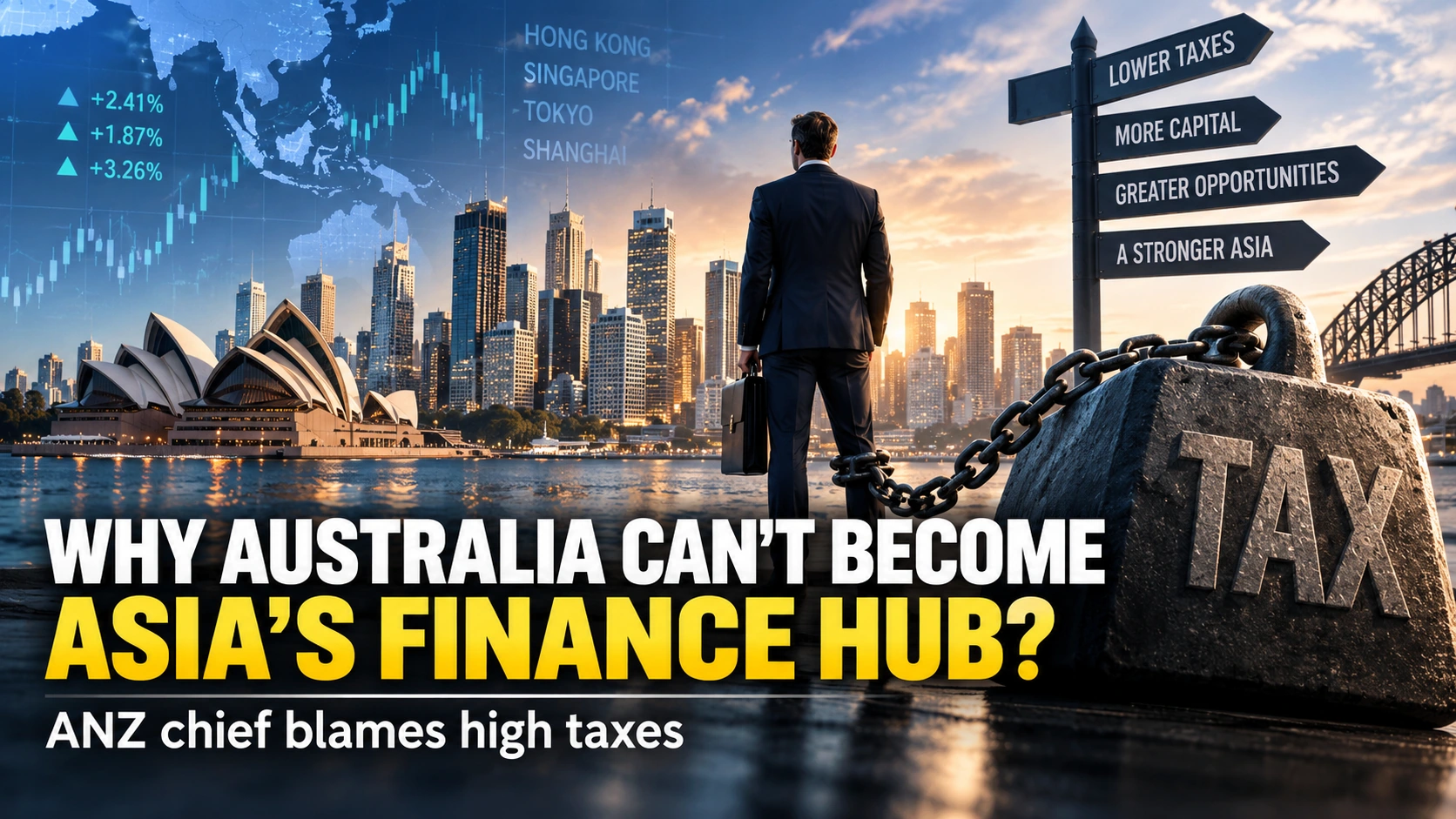
Australia has many ingredients of a major Asia-Pacific financial centre — deep savings, developed capital markets and a sophisticated banking system. ANZ CEO Nuno Matos says one missing ingredient is stopping it from competing with hubs such as Singapore and Hong Kong: a more attractive tax environment.
What Matos said
Speaking in Sydney, the ANZ chief argued that financial capital does not naturally move toward high-tax jurisdictions. He said Australia’s compulsory pension system gives it a large domestic savings pool and that its capital markets are developing strongly, but taxation weakens the international proposition.
Why Singapore and Hong Kong are the comparison
Matos pointed to the much lighter taxation of capital in those centres. His argument is straightforward: if international investors can deploy money in another regional hub with a lower tax burden, Australia needs a compelling reason for them to choose Sydney or Melbourne instead.
The policy backdrop has become tougher
Australia has legislated changes to capital-gains taxation, including the removal from July 2027 of the 50% discount for assets held longer than a year and a 30% minimum tax on net capital gains. It has also broadened the range of assets on which foreign residents can face capital-gains tax.
Why this matters beyond banks
A genuine financial hub attracts asset managers, trading firms, family offices, fintech companies, legal services and global headquarters. That creates high-value jobs and gives a city influence over regional capital flows.
The counterargument
Tax is only one factor. Stability, regulation, talent, time zone, market depth and quality of life also matter. Australia is strong in several of those areas, which is why the debate is not whether it has advantages but whether the tax trade-off is worth it.
Bottom line
Matos’ message is blunt: Australia has the infrastructure to be a bigger financial centre, but it cannot assume global capital will ignore the price of doing business there.
Source: Reuters