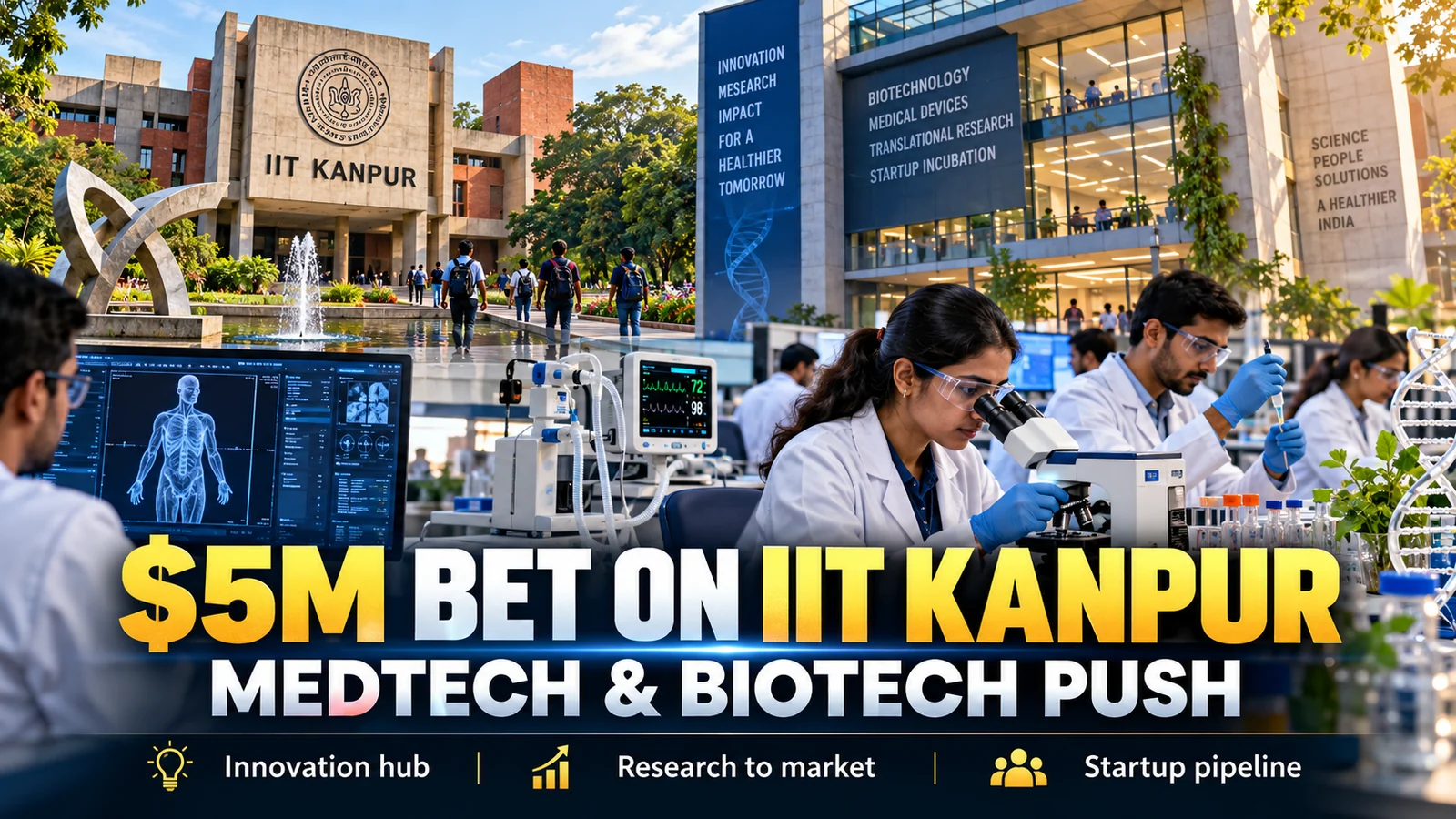
A $5 million investment at IIT Kanpur is targeting one of Indian research’s hardest problems: getting a promising laboratory idea all the way into the real world.
The Wadhwani Innovation Network, part of the Wadhwani Foundation, is committing the money over five years to establish a Centre of Excellence in medtech and biotechnology at IIT Kanpur. The programme is designed to support research after the discovery stage, when teams often struggle with intellectual property, regulatory requirements, product design, business strategy and the cost of commercial validation.
That gap is frequently described as the “valley of death” in innovation. Researchers may prove that an idea works scientifically but still fail to convert it into a product that hospitals, patients or companies can actually use. The initiative says only a small fraction of academic innovations currently make that transition.
The new centre is expected to operate from IIT Kanpur’s Technology Park using what the Wadhwani Innovation Network describes as a “hunt and fund” approach. Instead of waiting for every project to move through the same pipeline, the programme aims to identify promising technologies and surround them with the technical and commercial support needed for translation.
IIT Kanpur already works across areas that fit the model, including regenerative medicine, bioengineering and AI-enabled healthcare. That combination is important because modern medtech increasingly sits between traditional disciplines: a diagnostic device may need biology, electronics, software, data science, clinical testing and regulatory approval before it becomes commercially useful.
The investment is therefore not simply a grant for more academic papers. Its success will be judged by whether research reaches prototypes, trials, licensing deals, startups or products.
The programme is also linked to a larger Wadhwani effort to build a national innovation platform and expand support beyond a handful of elite institutions. If that model works, the IIT Kanpur centre could become a test case for how Indian universities commercialise research rather than allowing strong ideas to stall after publication.
The real challenge begins after the announcement. Medtech and biotechnology can require long development cycles, rigorous safety evidence and regulatory clearance. Five years and $5 million can create infrastructure and momentum, but meaningful impact will depend on the quality of the projects selected and whether researchers receive enough support to cross the difficult last mile from laboratory validation to real adoption.