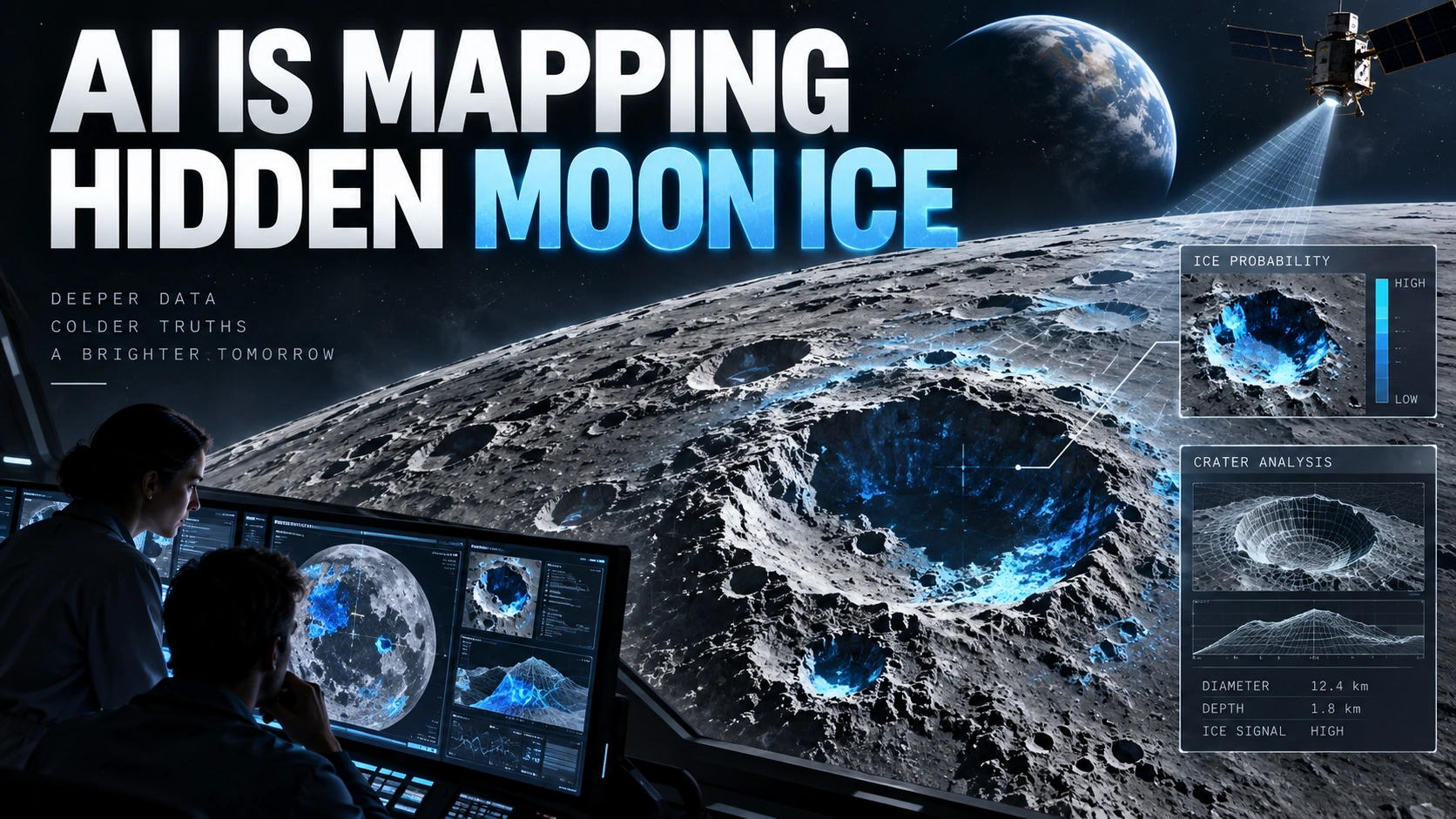
NASA and IBM have released an open-source Lunar Foundation Model trained on decades of Moon observations. The system combines data from multiple instruments and missions to help scientists identify features such as possible ice deposits, craters and volcanic formations more efficiently.
Why lunar ice is a major target
Water ice in permanently shadowed regions could support future astronauts and potentially be processed into oxygen or rocket propellant. Locating it accurately is therefore both a scientific question and a practical requirement for long-term lunar infrastructure.
The model combines data that was previously fragmented
IBM says the training dataset includes more than 30 spatially aligned layers from nine instruments across four missions, including NASA’s Lunar Reconnaissance Orbiter and GRAIL. Bringing different resolutions and measurements into one model can reveal relationships that are difficult to see in isolation.
The performance gains are task-dependent
IBM reported improvements of up to 23% over commonly used methods on certain lunar-feature tasks, with gains also in ice prediction and crater detection. The model is open source, allowing external researchers to test and extend it rather than relying on a closed system.
What comes next
Scientists will now see how well the model generalises across new regions and research questions. The biggest value may be as a foundation that other teams fine-tune for specialised lunar tasks.
Bottom line
The project is a good example of AI in science at its best: not replacing observation, but making an enormous archive of observation more useful.
Source: IBM / NASA