The Himalayas are often called Asia’s water tower. That is exactly why a new warning about accelerating glacier melt is so serious: if the region crosses a climate tipping point, the consequences will travel far beyond the mountains.
What the report is warning about
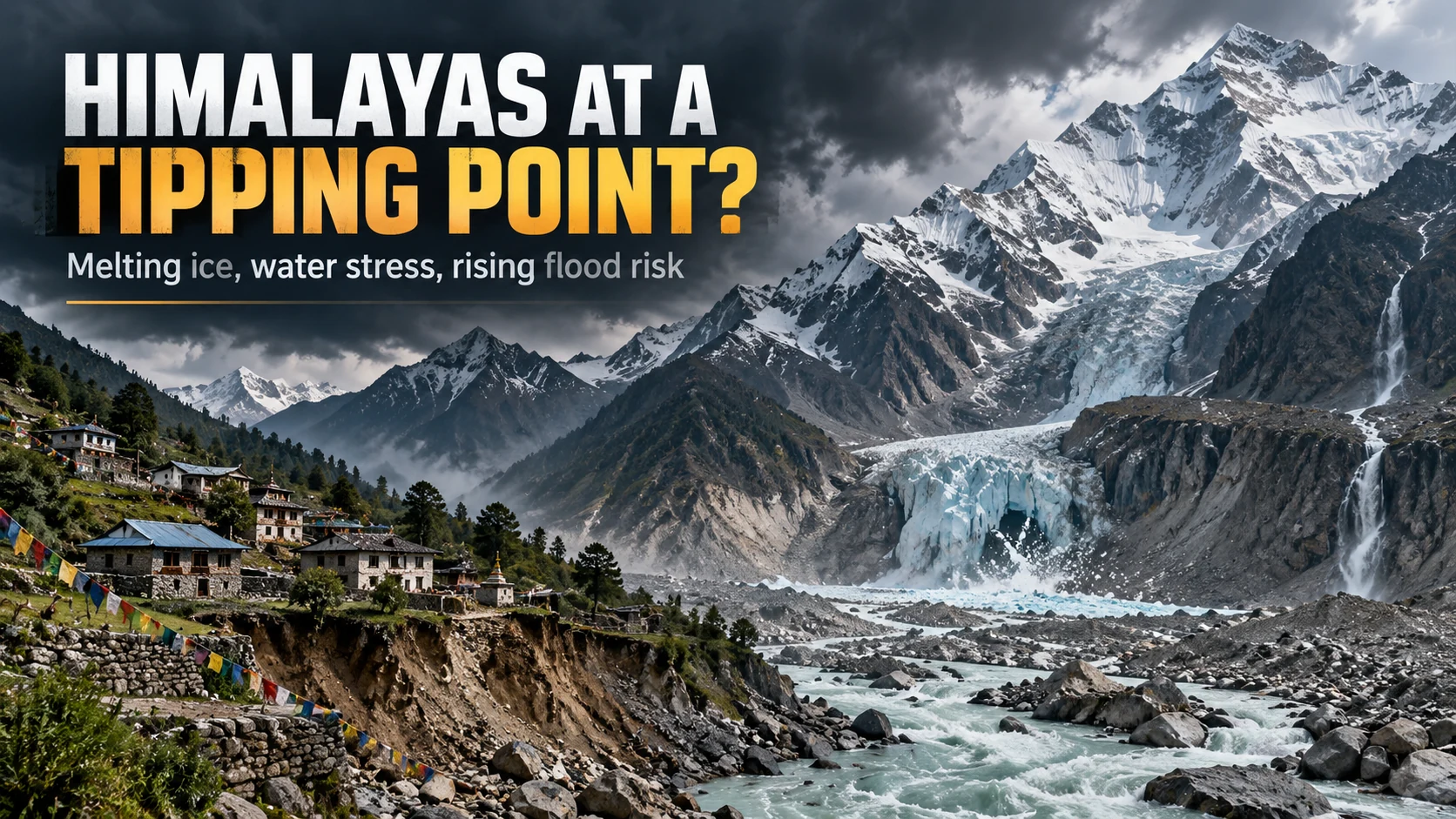
Glaciers across the Hindu Kush-Himalaya region are melting faster, while unstable glacial lakes are growing behind fragile barriers of ice and rock. Those lakes can burst suddenly, sending destructive floods into valleys below.
What “peak water” means
At first, melting glaciers can increase river flows. But researchers warn that by around mid-century some systems could reach “peak water” — after which the shrinking ice reserve means less water flows downstream over time.
Why India is exposed
India has nearly 200 glacial lakes identified as high risk, including dozens classified as very high risk. Hundreds of millions of people depend directly or indirectly on Himalayan river systems for water, farming, hydropower and livelihoods.
The monitoring gap
One of the most alarming details is how little of the region is continuously monitored. Only a tiny share of the estimated 40,000 glaciers are closely observed, making early warning and long-term planning much harder.
Why this is an economic story too
The Himalayas support a significant share of India’s economic activity. Disruption to water, roads, power projects, tourism and agriculture can quickly turn an environmental crisis into a national economic problem.
Bottom line
The danger is not a single future disaster. It is a slow change in the mountain system that can produce more floods now and less reliable water later — exactly the combination that makes a tipping point so dangerous.
Source: Reuters