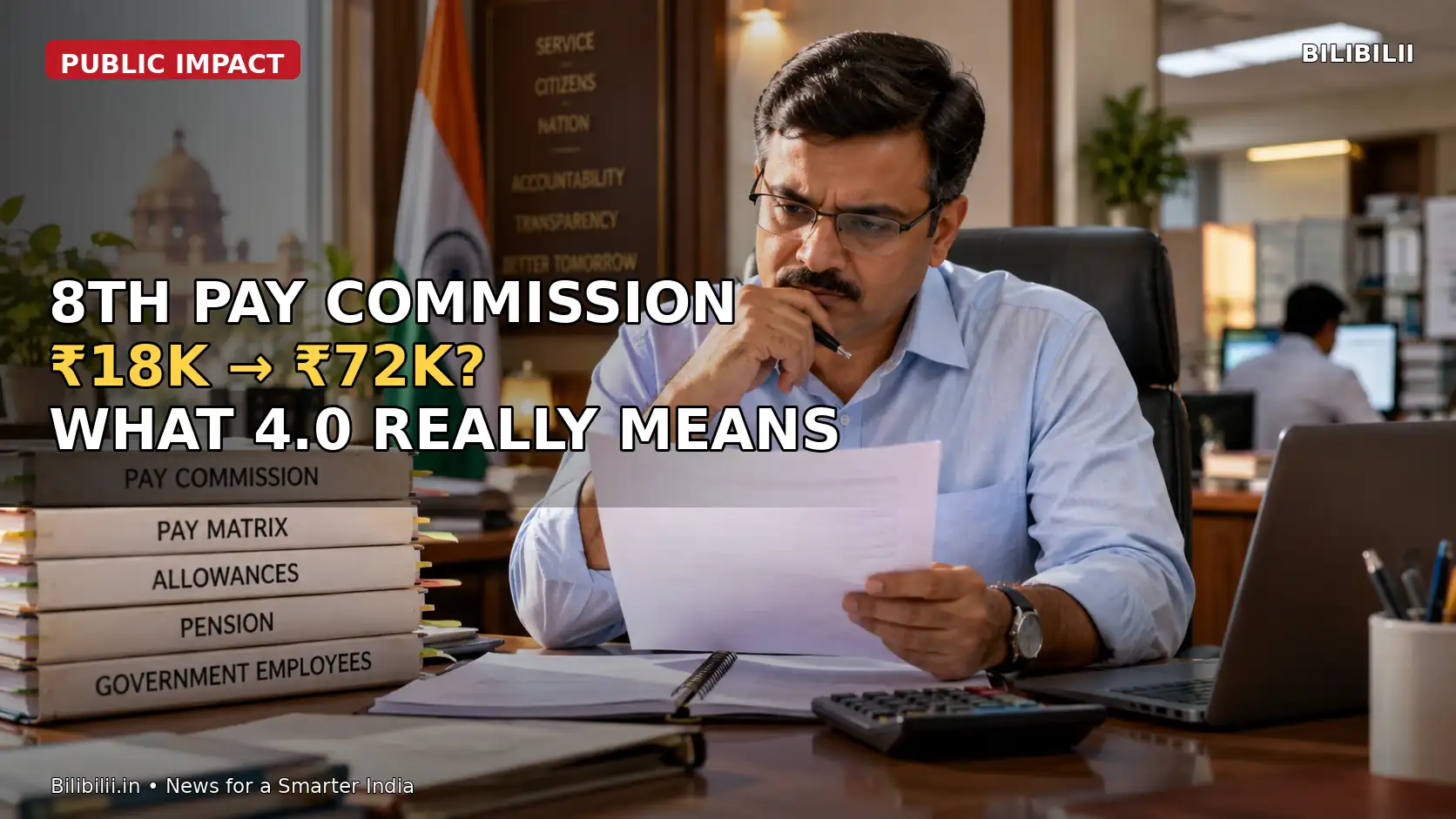
The numbers ₹68,940 and ₹72,000 are attracting enormous attention, but they are illustrations based on employee-group demands—not an officially approved new minimum salary.
Search interest around the 8th Central Pay Commission has risen again as employee and pensioner groups push for a higher fitment factor during consultations. Two numbers in particular—3.83 and 4.0—have become central to the discussion because they produce eye-catching salary calculations. The important point, however, is that neither number has been officially accepted as the final fitment factor.
A fitment factor is a multiplier used to convert existing basic pay into a revised basic-pay structure when a new pay commission is implemented. The basic calculation is simple: current basic pay multiplied by the chosen factor gives the illustrative revised basic pay. That is why a Level 1 minimum basic pay of ₹18,000 becomes ₹68,940 at a factor of 3.83 and ₹72,000 at a factor of 4.0.
Those figures are mathematically correct examples, but they should not be confused with a government decision. Employee and pensioner organisations have been presenting demands and proposals to the commission, while the commission is still consulting stakeholders and studying pay, pension and allowance structures. Its recommendation will ultimately have to be considered by the Union government before any revised pay structure becomes official.
The same caution applies to pension calculations. A higher multiplier can substantially change the illustrative basic pension, but the final pension framework will depend on the commission’s recommendations, implementation rules and the government’s decision. It is therefore too early for employees or pensioners to treat social-media salary charts as guaranteed future income.
There is another reason the headline multiplication can be misleading: basic pay is only one part of actual monthly compensation. Dearness Allowance, House Rent Allowance, transport-related benefits and other components are governed by separate formulas. When a new pay commission is implemented, some allowances can be revised, reset or restructured. A large increase in basic pay therefore does not translate one-for-one into an identical increase in take-home salary.
The current consultation phase also covers issues much broader than a single fitment factor. Employee associations have raised questions about allowances, pension protection, medical benefits, pay-level anomalies and the frequency of future revisions. Nursing organisations, for example, have recently placed demands around entry pay, night-duty allowance and insurance before the commission.
The 8th Pay Commission was formally constituted in late 2025 and has an 18-month period to prepare recommendations. That means the final structure remains a work in progress. Until the report is submitted and acted upon, calculations using 3.83 or 4.0 are best understood as scenarios that show the scale of change those multipliers would create.
For a government employee currently on ₹18,000 basic pay, the practical takeaway is straightforward. At 3.83, the illustrative revised basic becomes ₹68,940. At 4.0, it becomes ₹72,000. But neither figure should be entered into household budgets yet because the final multiplier, allowance treatment, implementation date and tax impact are still unknown.
The same principle applies at higher pay levels. A larger fitment factor mechanically produces a larger revised basic salary, but the policy decision involves fiscal cost, internal pay parity and pension liabilities across a very large workforce. Those considerations are exactly why pay commissions take months of consultations before producing recommendations.
The strongest Bilibilii takeaway is therefore not that a ₹72,000 minimum basic salary has been approved. It has not. The real story is that a 4.0 fitment-factor demand is now part of the public discussion, and the difference between a demand, a commission recommendation and a government-approved pay matrix matters.