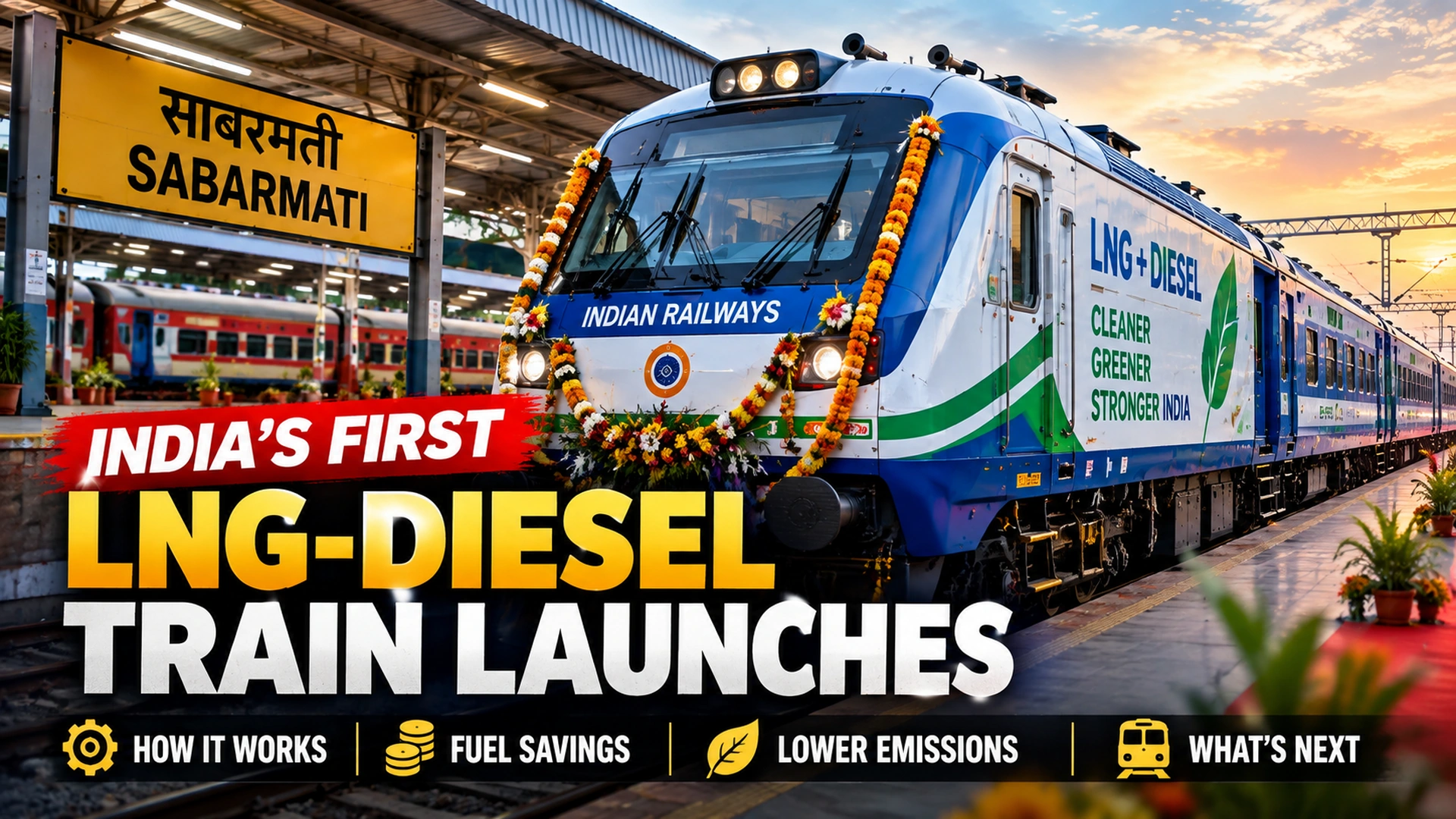
Indian Railways has launched the country’s first LNG-diesel dual-fuel DEMU train from Sabarmati in Gujarat, turning a long-running alternative-fuel experiment into a real passenger-rail trial. The inaugural run covers roughly 62 km between Sabarmati and Mahesana Junction, while Railways says the train’s final regular route is yet to be announced.
The core change sits inside two 1,400-horsepower Driving Power Cars. Their engines have been converted to use LNG alongside diesel, allowing the train to reduce its dependence on conventional fuel without losing the ability to keep running when LNG is unavailable. Railways says the converted units completed more than 2,000 km of field trials before the launch.
The economics are as important as the emissions story. Trial data cited by Railways puts estimated annual savings at around ₹11.9 lakh per power car, or about ₹23.9 lakh for an eight-coach rake. The system can replace a portion of diesel with LNG and is expected to reduce pollutants including carbon dioxide, nitrogen oxides and particulate matter.
This does not mean LNG is about to replace electric trains. India is electrifying its network rapidly, so the technology is more relevant to routes and duties where diesel-powered operation continues. The real test is whether the savings seen in trials survive routine service, maintenance demands and fuel-supply constraints at scale.