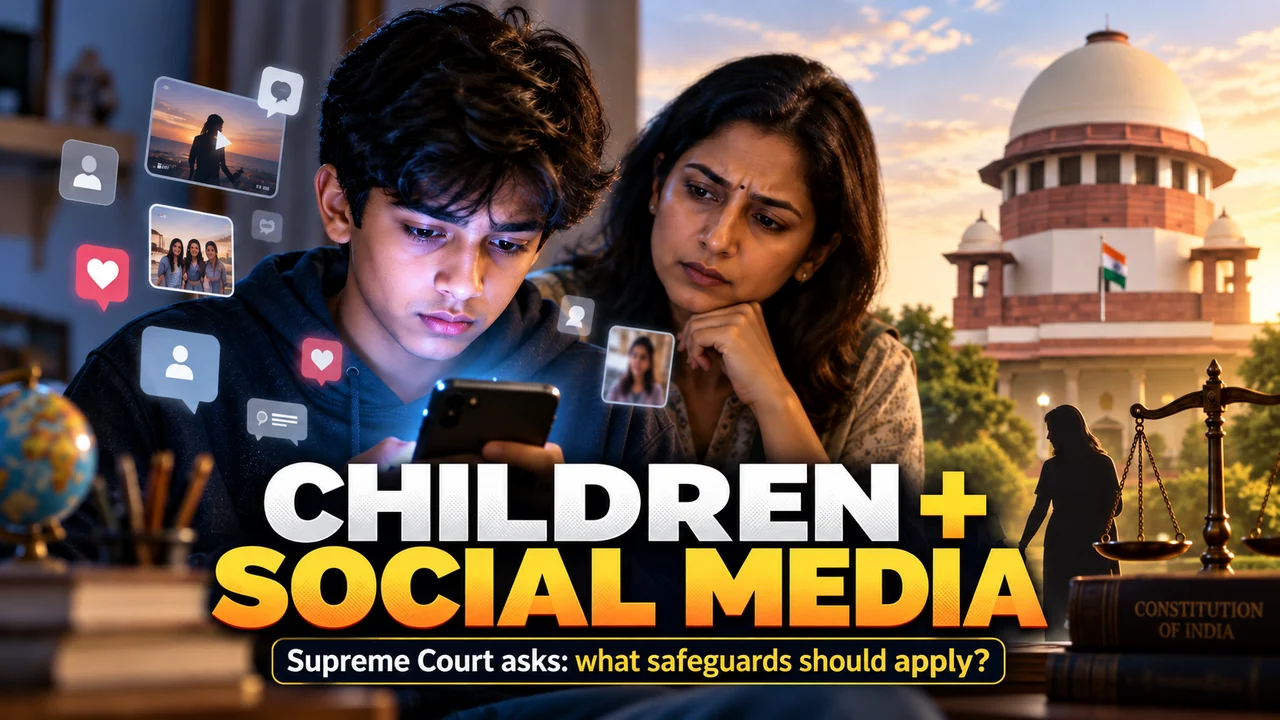
India’s next major social-media debate may be about whether children should be able to create accounts in the first place.
The Supreme Court has sought the Union government’s response to a petition asking for stronger safeguards on the use of social-media and digital platforms by minors.
Can a child agree to social-media terms?
Creating an account usually means accepting a platform’s terms and conditions. The petition points to Section 11 of the Indian Contract Act, under which minors generally lack legal capacity to enter contracts.
The argument is that if a child cannot legally enter a normal contract, there is a question over how that child can independently agree to a platform’s terms of service.
That does not automatically mean Instagram, YouTube, Snapchat or other platforms are about to be banned for children. The Supreme Court has not ordered such a ban.
What did the court say?
The court indicated that safeguards may be necessary. During the hearing, the bench discussed the need for protective “firewalls” and sought responses from the government.
The petition proposes stronger age and identity verification and suggests that younger users could access educational or age-appropriate material through accounts controlled by parents or guardians.
Why is the issue gaining urgency?
Children use social networks for entertainment, education, communication and gaming. But the same platforms can expose them to online grooming, sexual exploitation, sextortion, age-inappropriate material, cyberbullying, addictive design patterns and strangers posing as children.
The technical problem is harder than it sounds
A platform can ask users to type their birthday. A child can simply enter a different year. Stronger age verification could solve part of that problem, but it creates another one: privacy.
Should every teenager have to upload an identity document or submit biometric information just to use a social network? That is the trade-off policymakers will have to examine.
What happens next?
For now, the Supreme Court has asked the government to respond. There is no nationwide prohibition on minors’ social-media accounts arising from this hearing.
But the case could force India to answer a question platforms have largely handled themselves until now: Who should decide when a child is old enough for social media — the app, the parent, or the law?
Source: LiveLaw