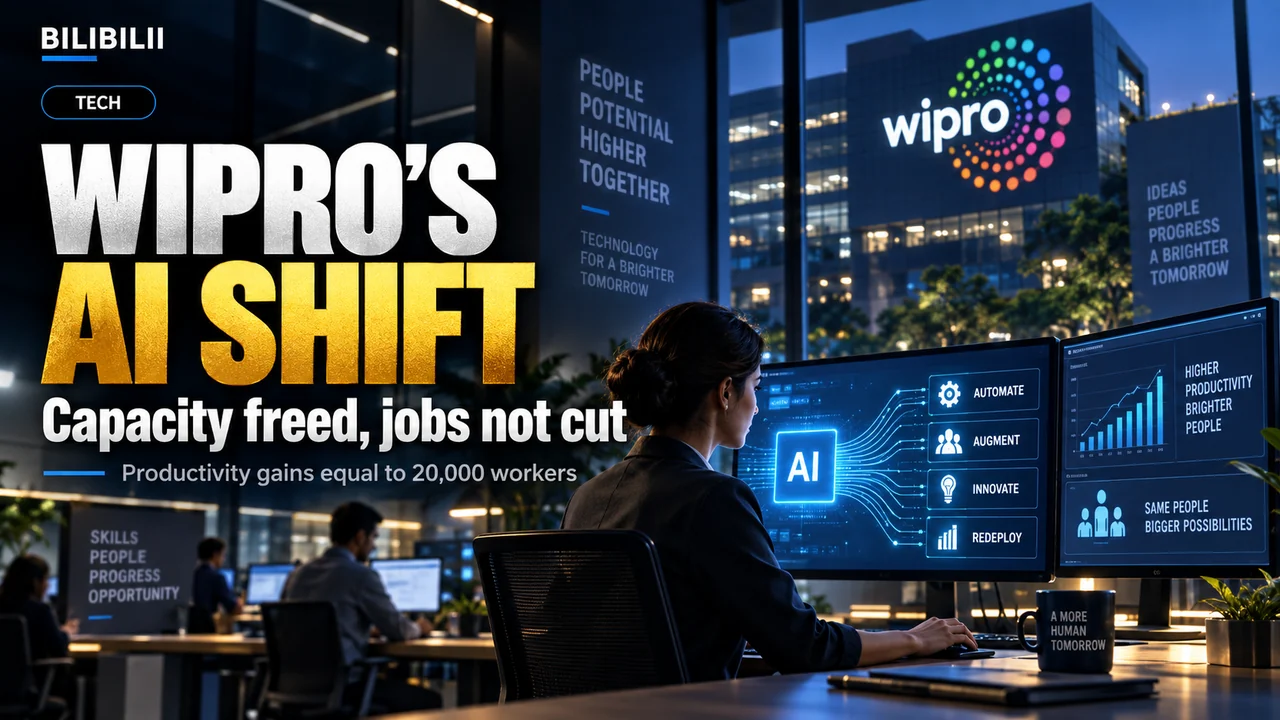
The number is dramatic: 20,000 workers. It is also easy to misunderstand. Wipro says AI productivity gains have freed capacity equivalent to the output of about 20,000 employees, but the company says those people were redeployed, retrained or moved into different work.
What “freed capacity” actually means
AI tools can reduce the time required for routine coding, testing, analysis and documentation. If the same team can finish more work in less time, the company has extra capacity even if the employees remain on the payroll.
Wipro is moving toward a human-AI model
The company has been training large numbers of employees in advanced AI skills and increasing the use of forward-deployed engineers who work closely with clients to turn AI experiments into operating systems and business workflows.
The entire IT-services industry is changing
Indian software-services firms are rethinking staffing, pricing and hiring as AI agents handle more repetitive work. That does not mean humans disappear, but it does change which skills are valuable and how many people are needed for certain traditional tasks.
Why the 20,000 figure matters
The figure shows the scale at which AI is beginning to affect the economics of service delivery. A productivity gain that once looked like a small experiment is now large enough to change how projects are staffed.
The real test is revenue, not just efficiency
Wipro’s leadership has argued that the important measure is whether AI improves customer outcomes, creates new revenue or solves business problems — not simply how many hours it saves.
Bottom line
This is not a 20,000-job layoff announcement. It is a sign that the same amount of technology work can increasingly be done with a different mix of people, tools and AI agents.
Source: Reuters