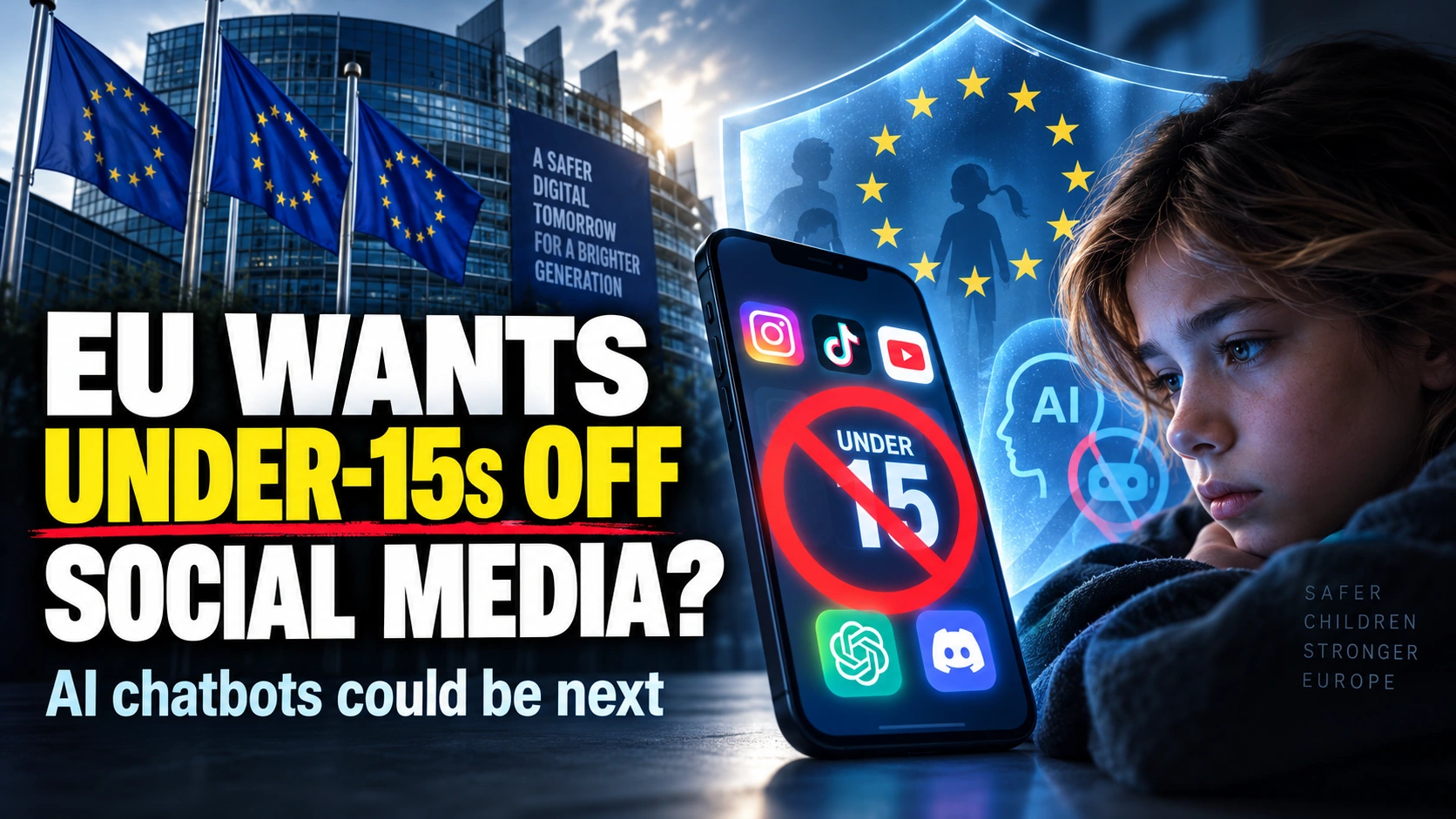
The European Union is preparing what could become one of the toughest child-safety rules anywhere in the world: restricting children under 15 from social media, video-sharing platforms, AI chatbots and online games.
What the EU is proposing
A European Commission document seen by Reuters says the plan would form part of an EU Kids Act. Under the draft, children aged 15 and above could create their own accounts. Children aged 13 and 14 could only use introductory social-media and video-sharing accounts opened by parents, with tighter contact lists and time limits.
Why this is bigger than a simple age limit
The proposal also targets product design. Platforms would be expected to avoid addictive features and harmful feeds, provide easier ways to report harmful content and offer effective parental-control tools. Social and video platforms would have to verify age at account creation, while online-game services would verify age before downloads.
AI chatbots are now part of the child-safety debate
That is a major shift. Online-safety rules once focused mostly on social networks and video platforms. The inclusion of AI chatbots shows regulators now see conversational AI as part of the same digital environment children use every day.
What companies could face
The draft also envisions a supervisory fee paid by companies to help fund enforcement. That means the proposal is not only about recommendations for parents; it would create direct compliance obligations for major platforms.
What happens next
The proposal still has to move through the EU policy process, and the final text could change. But the direction is clear: Europe is moving toward age-gated digital spaces rather than relying mainly on parental discretion.
Bottom line
If adopted in a strong form, the EU Kids Act could force some of the world’s biggest internet and AI companies to redesign how young users enter, use and experience their services.
Source: Reuters