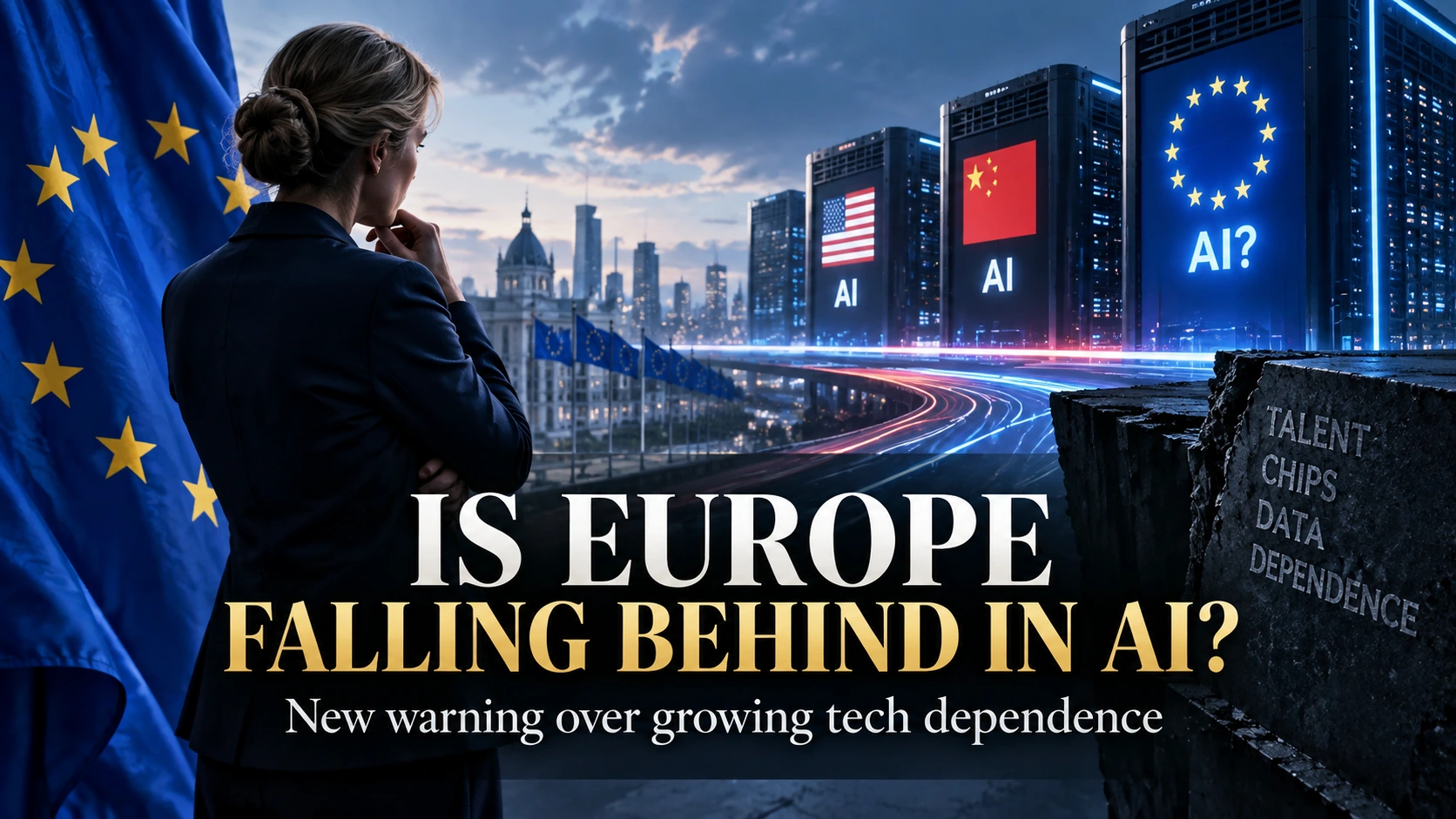
Europe is investing heavily in artificial intelligence, but ECB President Christine Lagarde says it has a dangerous weakness: much of the technology still comes from abroad.
What Lagarde is warning about
Speaking in Vienna, Lagarde said Europe faces an “unprecedented” risk if access to foreign AI systems were ever withdrawn or restricted. Her argument is that AI will soon sit inside essential systems — from border checks and tax audits to trains, hospitals and bank payments — making dependence on outside suppliers a strategic issue, not just a commercial one.
Why the U.S. matters so much
European companies have been adopting AI, but much of the computing capacity, cloud infrastructure and frontier-model capability comes from U.S. firms. That creates a new form of leverage. If access terms changed during a trade or political dispute, the effect could spread across multiple industries at once.
Europe’s infrastructure gap
Lagarde said Europe already has too little data-centre capacity for its own demand, and that the gap could grow more than sixfold within a decade if current trends continue. Her prescription is straightforward: build more European compute and develop models that are good enough for most tasks while running on European infrastructure.
The economic upside
This is not only about defence against a hypothetical cutoff. Lagarde argued that faster AI adoption could lift productivity by as much as 4% over a decade, potentially improving public finances and competitiveness.
The strategic dilemma
Europe wants the efficiency gains of U.S.-led AI while also reducing the dependency that comes with them. That is difficult because building data centres, chip access and model capability requires enormous capital and time.
Bottom line
Lagarde’s warning reframes AI as infrastructure. Europe’s question is no longer only “how fast can we adopt it?” but “who controls the technology we may soon depend on for everything?”
Source: Reuters