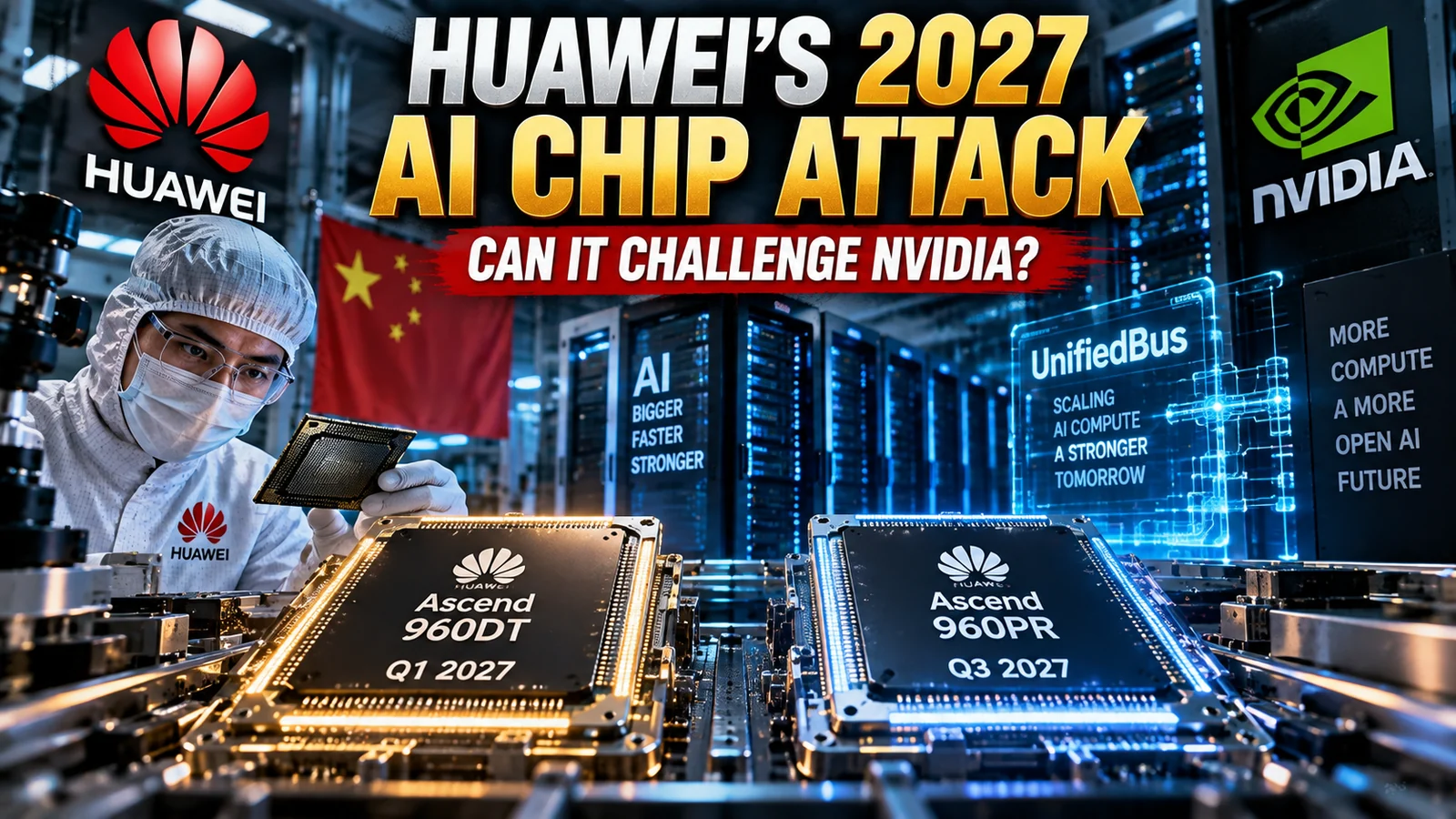
Huawei plans two new Ascend AI chips for 2027 as China accelerates domestic computing capacity. Here is what the 960DT and 960PR could mean for Nvidia competition.

Huawei has put a clear date on the next phase of its AI-chip push. The Chinese technology group plans to launch two new processors in 2027 as it tries to expand domestic AI computing capacity and reduce China’s dependence on foreign accelerators.
According to Reuters, the Ascend 960DT is expected in the first quarter of 2027, followed by the Ascend 960PR in the third quarter. The timing matters because advanced AI hardware has become one of the most strategically important parts of the technology industry, and export restrictions have made access to the most powerful US-designed chips more difficult for Chinese buyers.
Huawei is not competing only at the level of a single processor. It is also building systems designed to connect large numbers of chips together. Its UnifiedBus technology is intended to let many processors work as one larger computing system, an approach that could become increasingly important as AI models require more training and inference power.
Reuters reported that Huawei has assembled large superclusters capable of connecting huge numbers of processors and has already delivered more than 1,000 smaller supernode systems to hundreds of customers. That suggests the company’s strategy is not simply to copy a leading GPU, but to build an entire AI-compute stack around domestic hardware.
Nvidia still has a major advantage. Its chips dominate the global AI accelerator market, and its CUDA software ecosystem has years of developer adoption behind it. Hardware performance alone therefore will not decide the competition. Software compatibility, reliability, power efficiency, networking, supply, and customer support will all matter.
For China, Huawei’s 2027 roadmap has a broader significance. The country has made semiconductor self-reliance a strategic priority, and AI computing is one of the areas where that goal is most urgent. If Huawei can scale its new chips and systems successfully, it could strengthen China’s ability to train and run large AI models without depending as heavily on restricted foreign hardware.
The key question for 2027 will be whether the new Ascend products can move from national strategic importance to genuine market competitiveness. Nvidia remains the benchmark, but Huawei is making clear that it intends to compete across chips, interconnects and full computing systems rather than in one narrow category.
Why this matters
This development matters because it changes the choices available to users, businesses or policymakers in a fast-moving area. The key next step is to watch execution, adoption and any official follow-up.
Related coverage
- Nvidia Next Big Deal Antitrust Questions
- China Ai Safety Talks September 2026
- India Frontier Ai Compute Gap Analysis
Source: Reuters