A national workshop for women legislators has turned into a fresh debate over language and federalism.
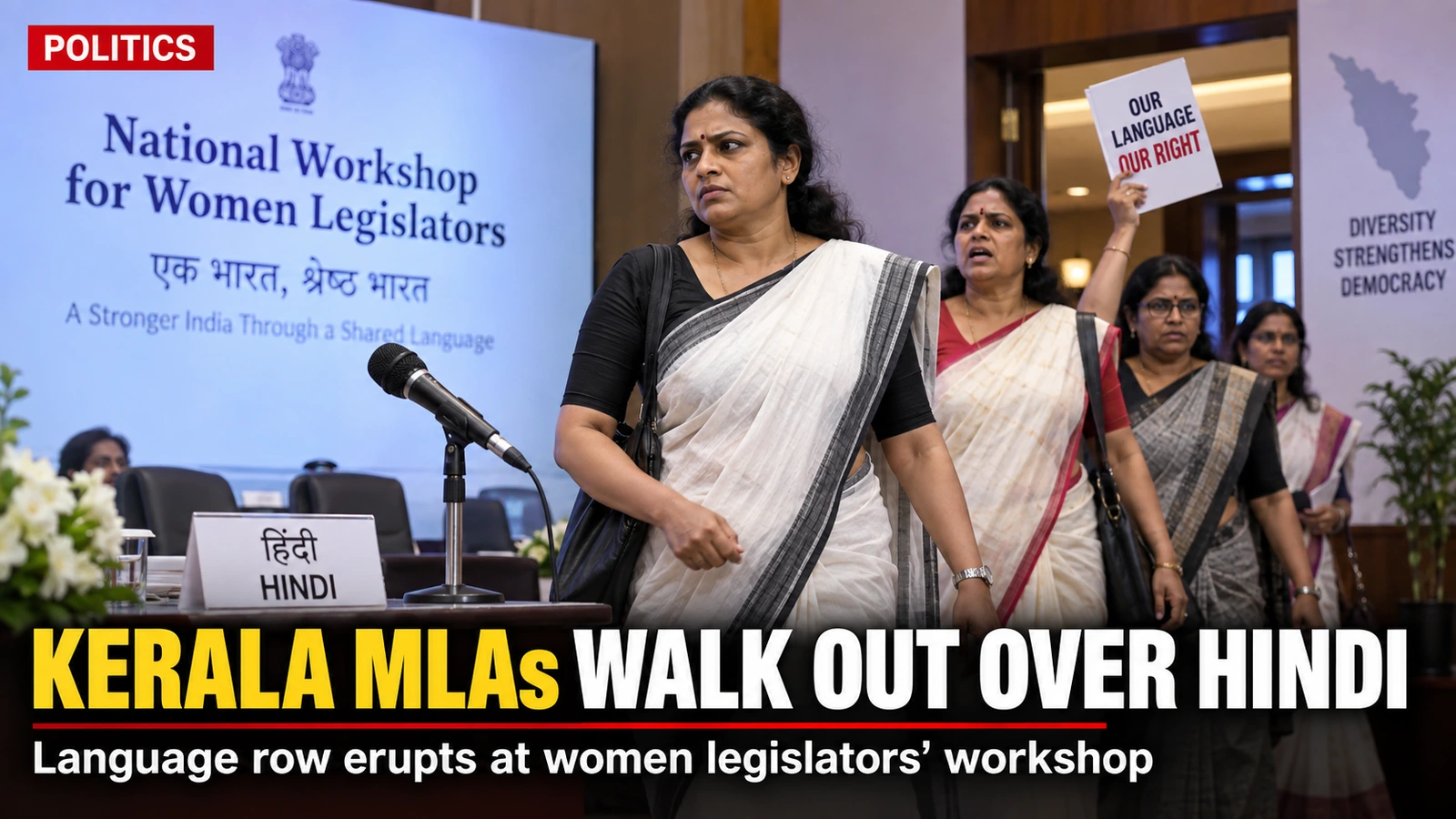
Eight women MLAs from Kerala walked out of a National Commission for Women event after objecting to what they described as the overwhelming use of Hindi at a forum attended by legislators from different parts of India.
What was the event?
The workshop was held under the NCW’s “She is a Changemaker” initiative and focused on gender-responsive governance for women legislators.
More than 100 women legislators from across the country attended the September 7-8 programme at Taj Surajkund in Faridabad.
Why did the Kerala MLAs object?
The legislators argued that a national-level programme involving representatives from multiple linguistic regions should provide meaningful space for languages beyond Hindi.
Their concern was not simply about personal comfort. They framed the issue as one of equal participation: a workshop is less inclusive if some elected representatives cannot easily follow or respond to the main proceedings.
The walkout quickly became political
After the incident, political leaders in Kerala accused the Centre of promoting Hindi at the expense of India’s linguistic diversity.
The dispute taps into a much older argument in Indian politics, particularly in southern states, over whether Hindi is being treated as a default national language in settings where participants speak many different languages.
Hindi is widely spoken — but India has no single national language
India’s Constitution recognises multiple scheduled languages, while Hindi and English have specific roles in the Union government’s official-language framework.
That distinction matters because debates about “Hindi imposition” often begin when people treat Hindi’s official role as if it automatically makes it the language every Indian must use at national events.
Why translation and interpretation matter
Modern national conferences have practical alternatives: bilingual presentations, live interpretation, translated material and simultaneous captions.
Those tools do not eliminate political disagreement, but they can prevent language itself from becoming a barrier to participation.
The larger question
India’s linguistic diversity is one of its defining features. That creates administrative complexity, but it also means national institutions have to think carefully about how “national” events are designed.
Bottom line
The Kerala MLAs’ walkout was about more than which language appeared on a microphone or presentation slide. It reopened a fundamental question: how does a multilingual country create shared national spaces without making some participants feel like guests in their own Union?
Source: The Indian Express