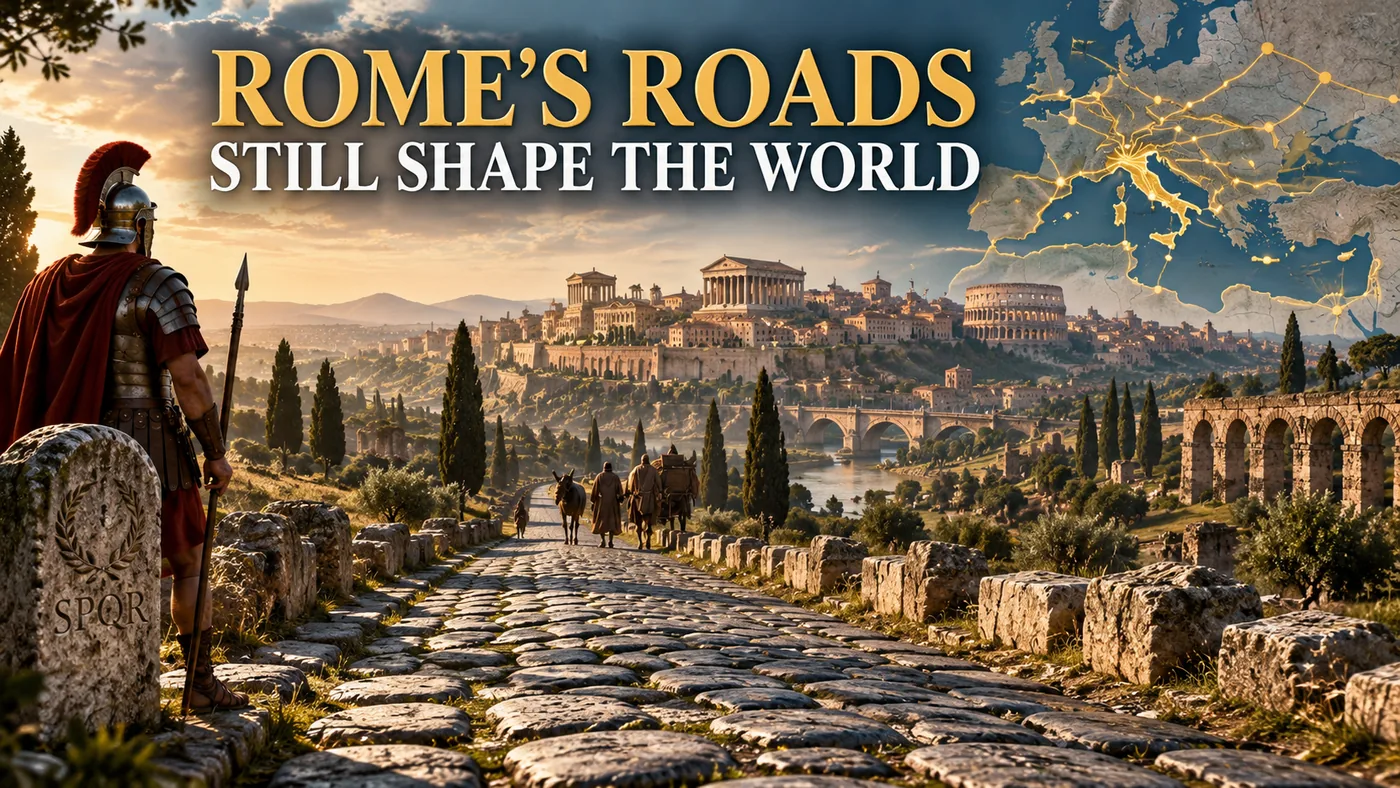
A fresh study on the Roman Empire’s road network has revived one of history’s most enduring fascinations: how roads built thousands of years ago still help explain the way people move today. The research does more than celebrate Roman engineering. It shows how infrastructure can outlive empires and continue shaping geography, trade and connectivity for centuries.
Why Roman roads remain so extraordinary
The Roman road system was vast, ambitious and deeply strategic. It connected distant territories across Europe, North Africa and the Middle East, enabling military deployment, commerce and administrative control on an extraordinary scale. The network became one of the clearest physical expressions of Roman power.
What makes the new study so fascinating is that it underlines the network’s long afterlife. Many later routes and even modern transport corridors echo the pathways established by Rome, proving that smart infrastructure decisions can shape movement far beyond the age that created them.
Why this matters today
Modern audiences often treat ancient history as something sealed off from daily life. But infrastructure tells a different story. Roads influence where people settle, how goods move and which places grow into hubs. Once a durable route becomes established, it can generate patterns that persist for generations.
That is why this research resonates beyond archaeology. It reminds us that built systems are not temporary conveniences — they can become civilisational skeletons.
The myth and the reality
The old phrase says that all roads lead to Rome. The study adds nuance to that idea, showing that the network was broader and more complex than a single symbolic centre. Connectivity mattered across regions, and in later eras other cities became crucial nodes in the system of overland movement.
Still, the symbolic force of Rome’s roads remains powerful because the basic insight still holds: political ambition, engineering and connectivity worked together to create a world-changing network.
What the bigger lesson is
The real lesson may be about foresight. Infrastructure, when designed well, becomes more than a project — it becomes a legacy. Roman engineers could not have imagined modern highways, but parts of their logic survived because they solved real geographic problems in durable ways.
That is why this story feels so compelling. It is a reminder that the ancient world is not as distant as it looks. Sometimes, the road beneath the modern journey still carries the memory of an empire.