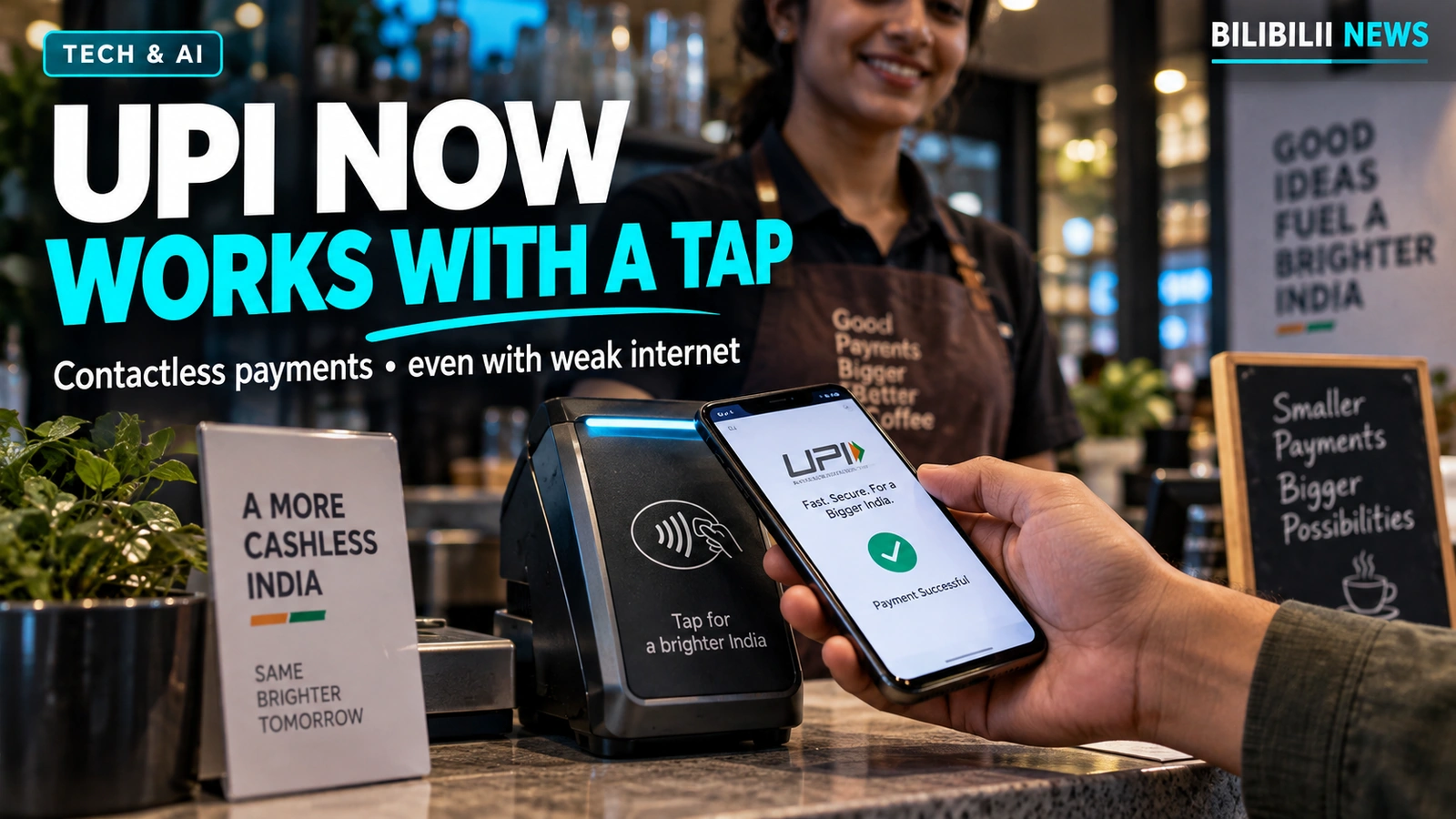
UPI is moving beyond scanning QR codes. India’s payments network has introduced a tap-and-pay option that allows users to complete supported transactions by tapping a smartphone at a point-of-sale terminal — without first opening a UPI app.
The feature, announced by the National Payments Corporation of India at the Global Fintech Fest in Mumbai, uses near-field communication, or NFC. It is designed to keep working even where mobile internet is weak or unavailable.
What changes for users?
The familiar UPI flow usually involves opening an app, scanning a QR code, entering an amount or confirming one provided by the merchant, and authorising the payment. The new contactless option aims to shorten that journey for compatible phones and terminals.
Instead of pointing a camera at a QR code, the user can bring the phone close to the payment terminal. The transaction still sits on top of UPI’s banking rails, but the physical interaction begins to resemble contactless card payments.
Why the offline angle matters
Contactless payments are most useful when they are fast. Requiring a strong mobile-data connection every time can defeat that advantage in crowded shops, transport hubs or areas with patchy connectivity.
NPCI says the tap feature has been designed to function in locations with little or no network connectivity. That could make it particularly useful for small-value retail transactions where speed matters more than a full app interface.
UPI is already enormous
In August, UPI processed 24.51 billion transactions worth ₹29.82 trillion, according to data cited by Reuters. That scale means even a small change in how people pay can affect millions of daily transactions.
Why Apple Pay is part of the story
The timing is important because Apple Pay is expected to move toward a fuller India launch after a beta phase. Apple’s wallet has helped normalise phone-tap payments in many markets, but India’s payments ecosystem is different because UPI already dominates everyday digital transactions.
That sets up an unusual contest. Rather than contactless cards competing with cash, India may see different contactless experiences competing on top of an already powerful bank-to-bank payment system.
Will every phone support it?
No. NFC support, device software and merchant-terminal compatibility all matter. Users should not assume every smartphone or every QR-only merchant setup will immediately support tap-and-pay.
What happens to QR codes?
They are not disappearing. QR payments remain cheap, widely deployed and easy for small merchants because they do not require an NFC terminal.
The more realistic outcome is that India ends up with multiple UPI interfaces: QR for universal reach, tap for speed, and future AI-assisted payment flows for more automated transactions.
Bottom line
UPI’s biggest strength has always been that it made bank payments feel simple. Tap-and-pay is an attempt to remove another step. If adoption is smooth, the next time you pay at a shop, you may not need to scan anything at all.
Source: Reuters