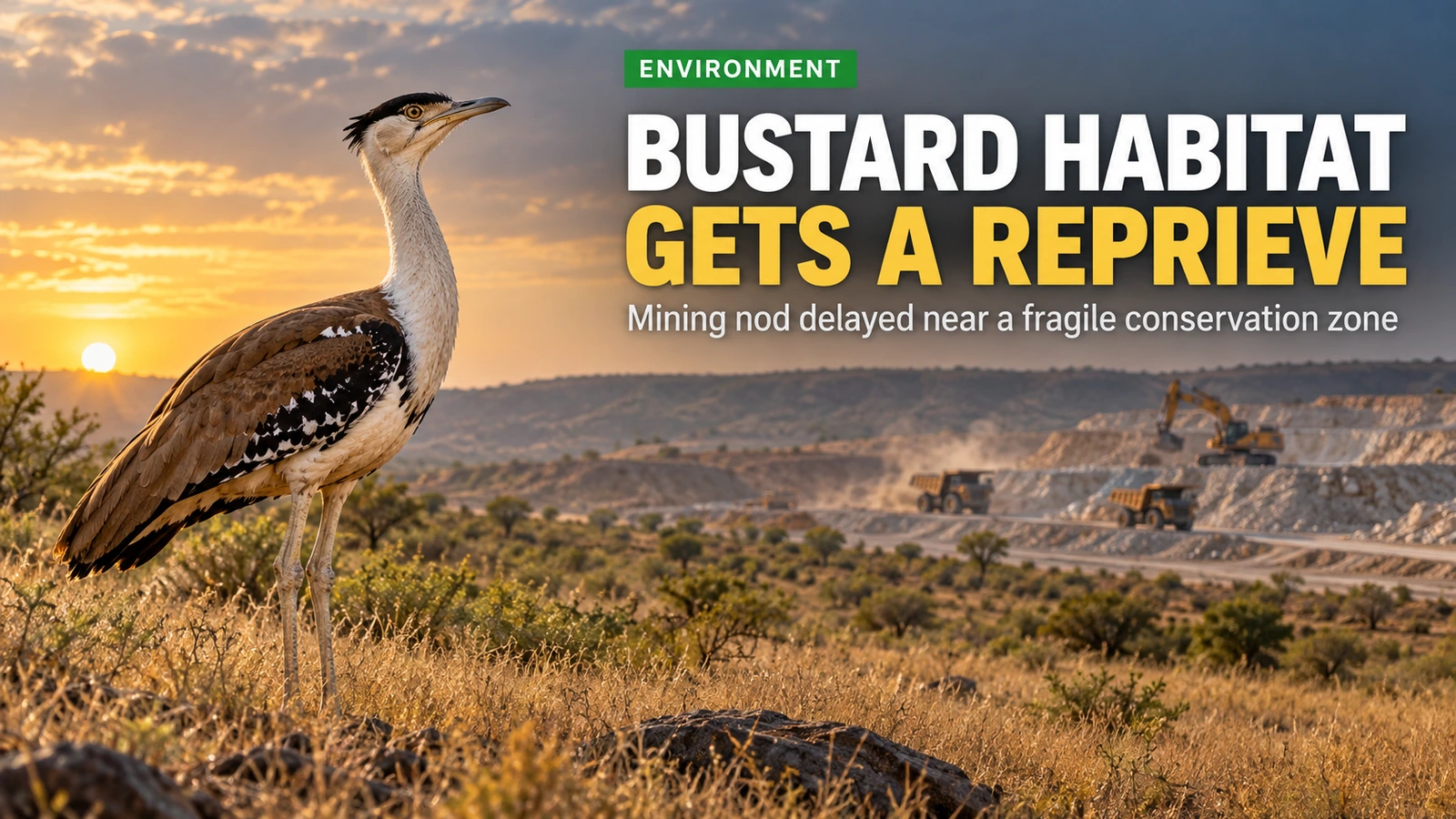
A proposed limestone mine close to habitat used by one of India’s most endangered birds has not received environmental clearance — at least for now.
An expert panel under the Union Environment Ministry has deferred a green nod for a Dalmia Bharat Green Vision Limited mining proposal near Ramgarh in Rajasthan’s Jaisalmer district.
Why is the location sensitive?
The proposed mining site lies about 1.77 km from a priority area associated with the Great Indian Bustard, according to official and company information cited by the Indian Express.
The species is critically endangered, with only around 130 individuals believed to remain in the wild in India.
What did the expert panel decide?
The panel did not permanently reject the project.
Instead, it deferred environmental clearance and asked for changes to the mining plan so that it aligns with the approved production capacity.
It also noted that recommendations from the Wildlife Institute of India must be followed.
Why is the Great Indian Bustard so vulnerable?
The bird depends on open grassland and arid landscapes, habitats that are often wrongly treated as empty or low-value land.
Infrastructure, mining, power lines and habitat fragmentation can all create additional pressure on a population that is already extremely small.
Power lines are another major threat
Great Indian Bustards are heavy birds with a relatively narrow forward field of vision, making collisions with overhead power lines a serious conservation problem.
The species has therefore become central to broader debates about how India should balance renewable energy, infrastructure and industrial development with habitat protection in Rajasthan and Gujarat.
Does the deferment stop mining permanently?
No. A deferred clearance means the proposal remains unresolved rather than cancelled.
The company may return with revised documents or additional safeguards, after which regulators can reconsider the project.
Why this decision matters
When a species is down to roughly a hundred-plus wild birds, the margin for error becomes extremely small.
Environmental review near such habitat is therefore not only about whether pollution can be controlled. It is also about whether industrial activity changes the landscape in ways a critically endangered species cannot tolerate.
Bottom line
The Great Indian Bustard has not “won” the mining fight, and the project has not been permanently blocked. But the deferment creates a pause — and in conservation, a pause can matter when regulators still have the chance to redesign or reconsider what happens next.
Source: The Indian Express