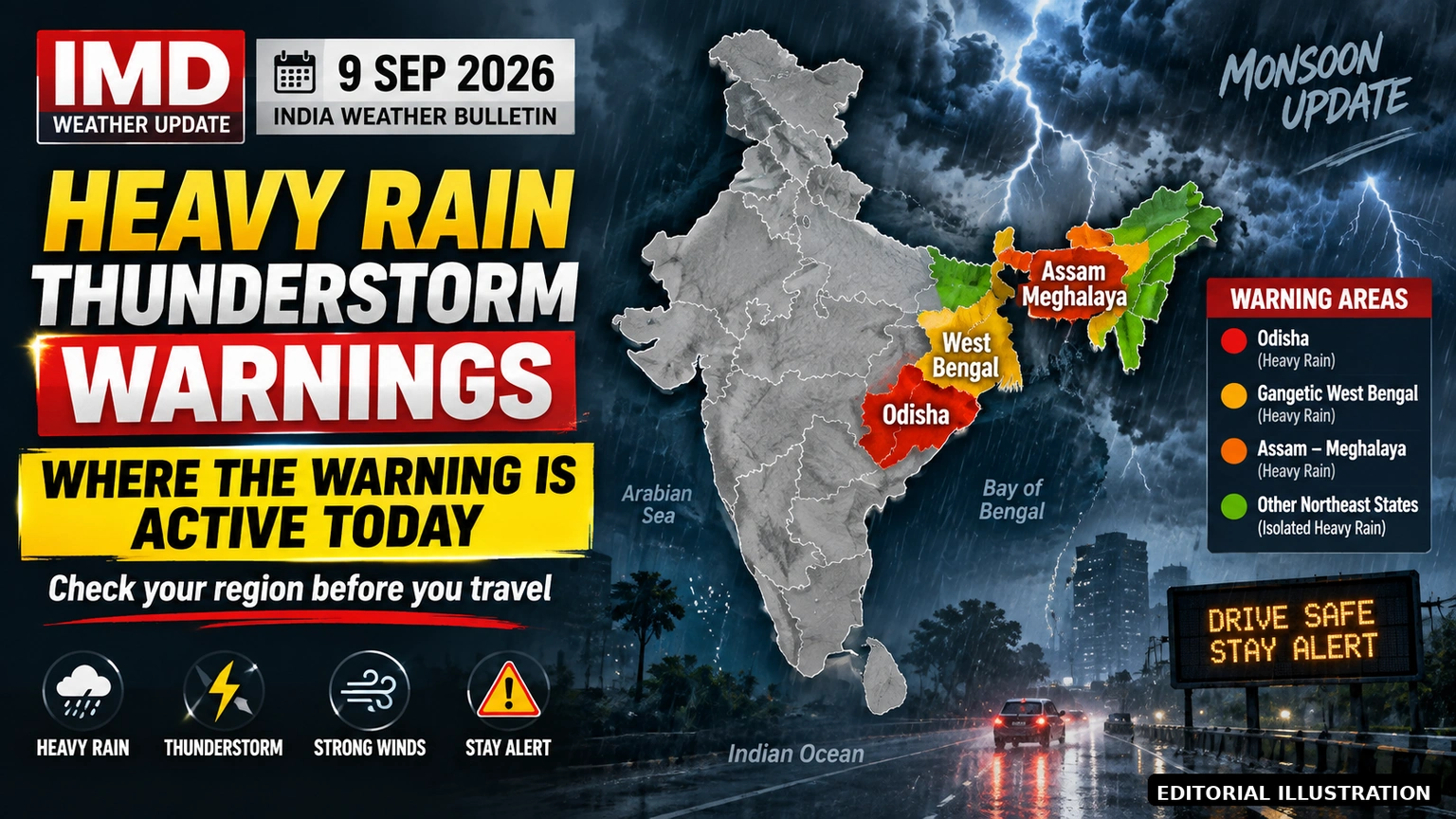
Weather headlines can make it sound as if the whole country is under the same alert. The India Meteorological Department's own warning pages show a more complicated picture for September 9: some subdivisions have heavy-rain and thunderstorm warnings, while others show no warning at all.
Where IMD shows heavy-rain warnings today
On its subdivision-wise warning pages issued for September 9, IMD lists heavy rain along with thunderstorm, lightning or squall-related warnings for Odisha and Gangetic West Bengal.
Assam and Meghalaya are also shown with a heavy-rain warning for September 9, along with thunderstorm and lightning-related conditions. Other northeastern areas have separate warnings depending on the regional meteorological centre.
What about Delhi?
This is where checking the official page matters. IMD's subdivision page for Haryana, Chandigarh and Delhi showed “No warning” for September 9 at the time checked. That does not mean rain is impossible. A formal warning category and an ordinary forecast are different things.
Weather conditions can also change during the day, which is why IMD issues nowcasts and district-level alerts separately from multi-day subdivision warnings.
Why Odisha and Bengal need attention
IMD's Bhubaneswar page lists heavy rain plus thunderstorm/lightning/squall conditions for Odisha on September 9 and escalates to a very-heavy-rain warning for September 10. Gangetic West Bengal's September 9 warning also includes heavy rain and thunderstorm-related conditions.
For travellers and commuters, the practical risks are localised waterlogging, poor visibility, lightning and short-duration disruption rather than a uniform statewide shutdown.
How to read an IMD warning correctly
There are three layers worth checking: the broad subdivision warning, the district warning and the short-term nowcast. A viral image or a national headline may summarise a large area, but your city can have a very different risk level.
If you are travelling through a region under a thunderstorm warning, avoid sheltering under isolated trees, watch for waterlogged roads and check transport updates before leaving. In hilly areas, intense rain can also raise landslide and road-blockage risks.
The key takeaway
September 9 is not a single “India-wide red alert.” Official warnings are patchy and regional. Odisha, Gangetic West Bengal and parts of the Northeast are among the areas with active heavy-rain warnings, while other subdivisions may have lower-level or no formal warnings.
Sources checked: IMD subdivision-wise warnings issued September 9, 2026 by the Bhubaneswar, Kolkata, Shillong and Delhi-region meteorological centres. Weather alerts can be updated after publication.
Featured image is an AI-generated editorial illustration used for representational purposes. Readers should rely on the latest IMD map and district warnings for decisions.