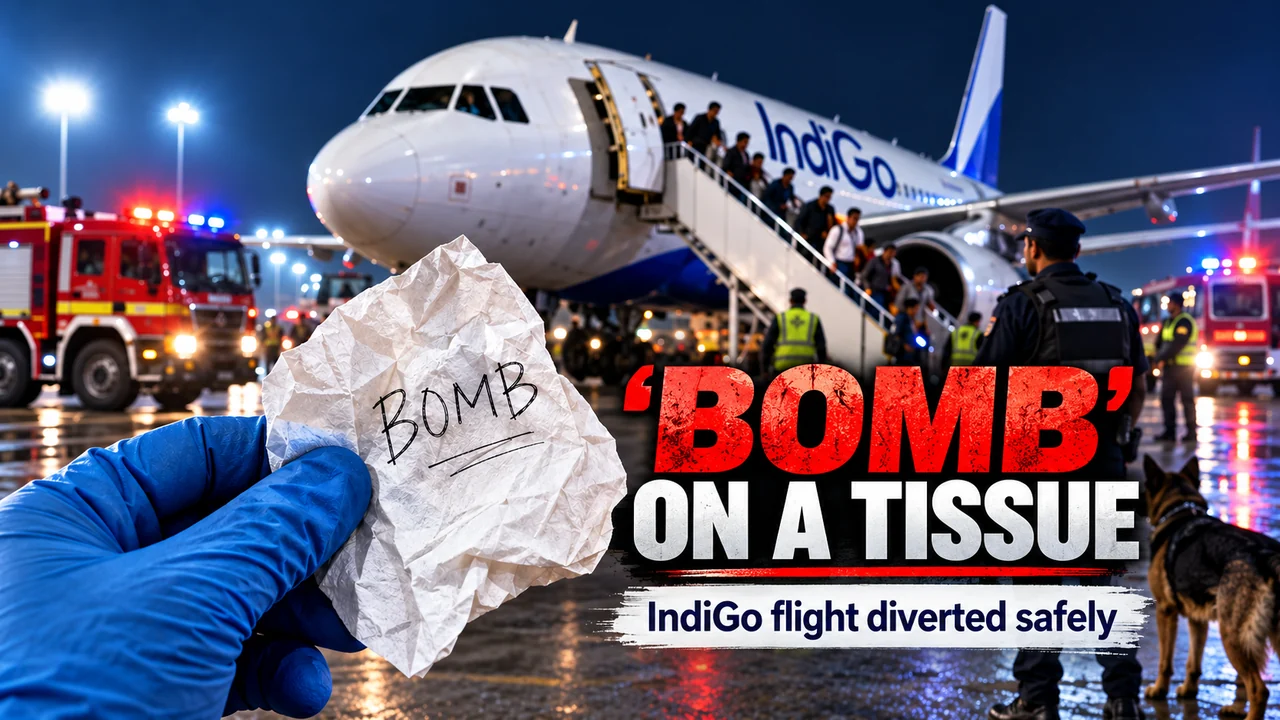
A piece of tissue paper with one alarming word was enough to divert an international flight carrying more than 100 people.
An IndiGo aircraft flying from Lucknow to Dammam in Saudi Arabia made an emergency landing in Ahmedabad after cabin crew discovered a bomb-related message in the lavatory.
The aircraft landed safely. No suspicious object was found during the subsequent security search.
What happened onboard?
Flight 6E 97 was travelling to Saudi Arabia when the threat was discovered. Once the warning was reported, aviation-security protocols were activated and the aircraft diverted to Ahmedabad’s Sardar Vallabhbhai Patel International Airport.
Passengers and crew were safely removed while security agencies inspected the aircraft.
Why the tissue paper is significant
This was not the first incident of its type. Only around ten days earlier, another India-Saudi route flight was forced into an emergency landing after cabin crew found the word “bomb” written on a tissue in a lavatory.
The similarity between the incidents is now part of the wider security concern.
Why can’t an airline simply ignore an obvious hoax?
Because nobody onboard can know with certainty that it is a hoax. A vague handwritten warning may appear ridiculous, but aviation security is built around worst-case risk.
Even a crude message can trigger diversion, priority landing, passenger evacuation, aircraft isolation, baggage searches and police investigation.
False threats have real costs
Fuel is wasted. Passengers miss connections. Airports divert resources. Crews can exceed duty limits. The aircraft may remain out of service while searches are completed.
What happens next?
Investigators will want to determine who wrote the warning and whether recent similar incidents are connected.
For passengers, the diversion ended safely. But that safe ending is exactly why airlines respond aggressively to such threats.
Source: The Indian Express