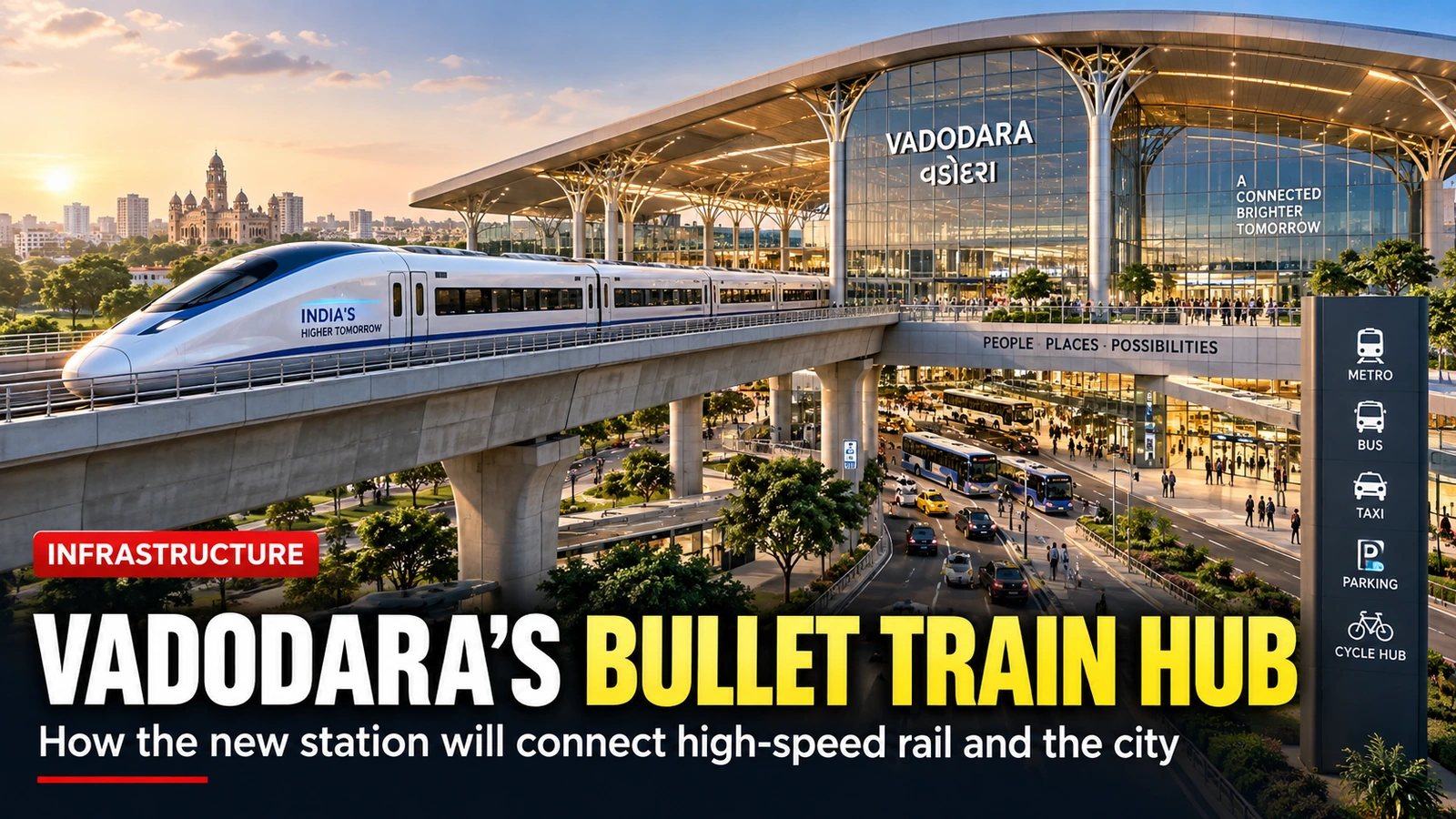
Vadodara’s bullet train station is being designed less like an isolated terminal and more like a transport interchange built directly into the city.
The high-speed rail station will be located above Platform 7 of the existing Vadodara railway station, allowing passengers to move between the Mumbai-Ahmedabad bullet train corridor and conventional Indian Railways services.
Why build the station above an existing platform?
High-speed rail stations can become inconvenient if passengers have to travel far outside a city before beginning or ending their journey.
Vadodara’s design uses the existing railway complex as the anchor, placing the new station where major passenger movement already happens.
The goal is a multi-modal hub
The station is being planned to connect with the existing railway station, nearby bus services and city road transport.
That matters because the total travel time of a bullet-train journey is not just the time spent onboard. It also includes getting to the station, changing modes and reaching the final destination.
Platform 7 becomes the key link
Building the high-speed station above Platform 7 creates a vertical connection between the new corridor and the conventional rail network below.
If the interchange is designed well, a passenger arriving on a regular train could transfer to high-speed rail without making a separate cross-city trip.
Why Vadodara matters on the corridor
The city sits on the Mumbai-Ahmedabad high-speed rail alignment in one of India’s most economically active regions.
Its existing rail station already handles substantial long-distance and regional traffic, which makes integration particularly valuable.
A station is more than a platform
Modern transport planning increasingly focuses on the area around a station: pedestrian movement, bus access, taxis, parking, pickup zones and the ease of changing between services.
A fast train can lose much of its advantage if passengers spend another hour navigating poor connections at either end.
What should passengers watch for?
The most important details will be transfer distances, escalator and lift capacity, signage, crowd management and links to buses and local road transport.
Those practical elements will decide whether the station feels genuinely integrated or simply stacked above another station.
Bottom line
The bullet train will attract attention for speed, but Vadodara’s station may be equally important as a test of integration. The project is trying to connect high-speed rail to the transport network people already use — rather than asking the city to reorganise itself around an isolated terminal.
Source: The Indian Express